The Inca Trail Guide
This guide is for anyone thinking of doing, or has booked onto, an Inca Trail trip with Best Andes Travel.
The Inca Trail
It’s one of the world’s most famous treks and Machu Picchu, the destination, was the archaeological find of the 20th century. The traditional trail is just 33km long but takes you on a magnificent four-day journey through cloudforests and over stunning peaks, past beautiful ruins onto the lost city of the Incas, built over 500 years ago, deserted and left untouched until 1911. This is an introduction to walking the trail, it provides useful background information and an overview on what to expect and how to prepare for this memorable experience.
Inca history
There are many books written on Machu Picchu and the Inca Empire. For a greater insight before your trip we recommend reading Lost City of the Incas by Hiram Bingham, the man who discovered the ruins.
The Inca Empire dominated Peru, Bolivia and Ecuador for just over 100 years from approximately 1430-1530. During this time the various tribes united and a great civilization grew. Their advances in medicine, agriculture and civil engineering were not surpassed anywhere in the world at the time.
Southern and central America became of great interest to the Spanish, as it boasted many riches, including an abundance of gold which the Incas never appreciated their fascination with. After the conquest of the Mayan and Aztec cultures, the conquistadors, led by Pizarro, headed into Peru and the Inca Empire. In 1532 they executed the great Inca Emperor, Atahualpa, and for the next thirty years the Spanish grew in dominance setting up the present day capital, Lima, while the remaining Incas lived virtually independently high in the Andean Mountains. Vitcos was the military headquarters of this isolated civilization and Vilcapampa was the major royal residency which was never discovered by the Spanish. The last stand of the Incas was led by Tupac Amaru, but in 1572 he was captured and executed and with him the last remnants of the Inca culture disappeared.
The discovery of Machu Picchu
So what was Machu Picchu, it was not mentioned in any of the conquistadors’ accounts?
Hiram Bingham, was a professor at Yale who yearned for fame. He set up the South America Collection at the University and was consistently seeking sponsorship to explore the continent. He was inspired by Rudyard Kipling’s
Explore:
‘Something hidden! Go and find it! Go and look beyond the ranges – something lost behind the ranges. Lost and waiting for you! Go!’
It should also be noted at the same time Bingham was discovering Machu Picchu and the Inca Trail, Conan Doyle was releasing his book The Lost World. All this adds to the romance of the discovery of Machu Picchu and his story lends itself to the image of explorers looking for ancient treasures in unchartered lands.
Bingham actually went in search of the lost city of Vitcos, the last capital of the Incas where Manco Inca ruled, but, as with all explorers, he lived on rumours and hearsay and, having set off out of Cusco, he stayed with locals who talked about ruins up on the hill. He went there the next day and paid little attention to what he found leaving a few members of the team to excavate the site while he went on in search of Vitcos. His search was not in vein and he successfully discovered both Vitcos and Espiritu Pampa (Vilcapampa), the last Inca stronghold for Tupac Amaru high up the Vilcapampa Valley. When he returned a year later he realised the extent of the site he had stumbled on after the initial excavations and the legend of Machu Picchu began to take shape. Bingham publicised the findings in National Geographic and it captured the imagination of the world at the time; the discovery of an ancient world on such a scale, in such an inspiring location was unrivalled. Over the next few years he not only excavated the site but also the sites which lead up to Machu Picchu; uncovering the Inca Trail and the mystery began to be unravelled. It’s well worth trying to see the original pullout poster of the excavation work at Machu Picchu in National Geographic to help understand the magnitude of this find. It essentially created the Hollywood image of explorers discovering lost tombs and treasures.
What was Machu Picchu?
No one can blame Bingham for dismissing the site initially as just a few rural buildings – it was not chronicled anywhere. However there is no doubt, due its scale and amazing stonemasonry, this was an important site which played a central role in the Inca Empire. It’s very probable that the site was deserted before the conquistadors’ arrival, hence them not mentioning it in any chronicles and its untouched survival. The most plausible explanation of its role is it was built as a retreat for the most powerful of all Inca Emperors, Pachacuti. His descendents did the same at other sites and this would explain it being uninhabited after his death and therefore lying unnoticed during the conquistador invasion.
Other theories are it was a place of religious importance and the remains up the Inca Trail were associated with the spiritual journey to the citadel. Other theories include an ancient observatory or frontier trading post, which reduced in importance as the Empire expanded. On the trek you’ll be able to make your own interpretation of the ruins. Machu Picchu and the Inca Trail have this amazing romantic tie and it’s easy to see why.
The Inca Trail & Best Andes Travel
We’ve been running trips along the Inca Trail since we started over thirteen years ago. There is no doubting it’s a popular trip and you can travel with various companies. 500 people a day can start the Inca Trail and Machu Picchu is limited to 2500 visitors a day (people can arrive by train as well) and during the summer months this allocation is taken.
So why travel with us?
We get great feedback from all our passengers, which is testament to our long standing relationship with our local tour operator, who again we have been working with since we started.
We’ve therefore accumulated a great knowledge of how to run the trips; we know what works and what you need to take.
All our guides are local and you stay in locally owned accommodation throughout. Each itinerary is designed to invest as much as we can into the local economy.
What’s more our guides speak Spanish and good English, so can answer any of your questions and can bring the ruins alive. They are also experienced mountain guides and can read the localised mountain conditions.
Our team will look after everything; you’ll have cooks and porters who’ll prepare your meals and camp everyday, leaving you free to enjoy the trek. We’ll also look after all logistics getting you to and from the trail and permit applications.
Peru is such an amazing country with amazing people, who have touched my life deeply. Everything was totally organised, right down to the minute detail. Dante our tour leader is incredible and very passionate about his country and what it has to offer. At every opportunity he took us off the beaten track to experience Peru the Peruvian way.
Julie Deuchars, Classic Peru
We also have six trips designed to offer an option that suits you. See ‘The Trips’ to see which one is best for you.
Best Andes Travel facts
We took 470 passengers on the Inca Trail last year
Across our Inca Trail trips 96% of passengers rated them ‘good’ or ‘excellent’ last year
And 98% of passengers rated their Group Leader as ‘good’ or ‘excellent’
What is it like on the trail?
If you’re looking for firsthand accounts visit our dedicated Inca Trail web page which has a selection of videos and blogs from people who have been on the trip, bestandestravel.com/inca-trail
This was my first trip with Best Andes Travel. I have been on a number of adventure holidays and I can honestly say that this was the best one I have ever been on!
Mr Sproul, Empire of the Inca
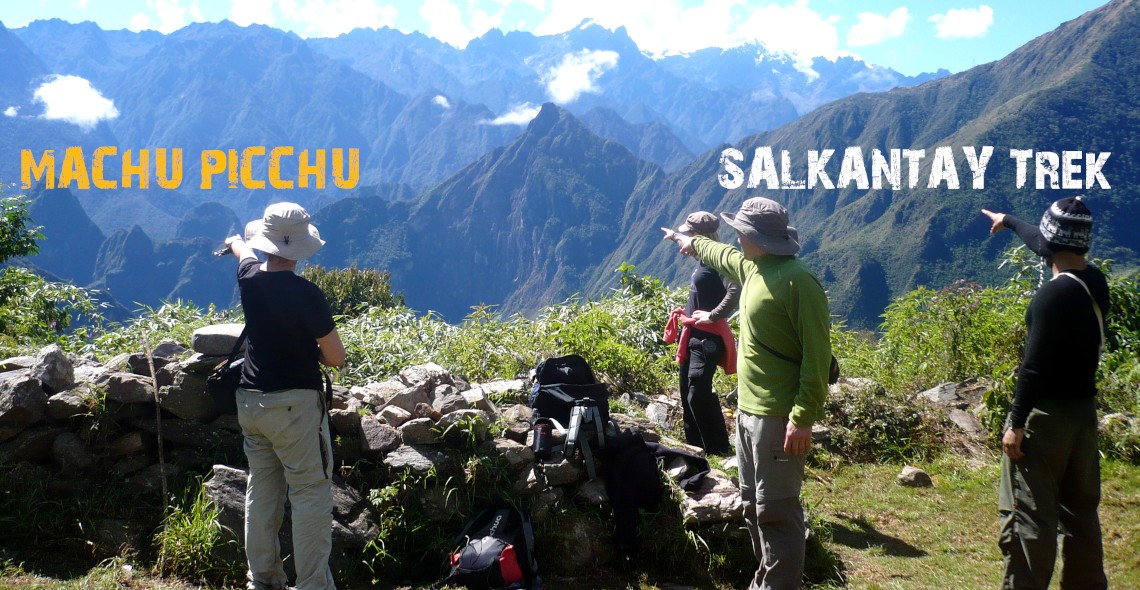
In essence you’ll walk for around seven hours each day, taking regular breaks at Inca ruins to take in the stunning mountain views. Each night you’ll stay in a two person dome tent and enjoy a hot meal in the communal eating tent. There will be a separate latrine and you’ll get a bowl of warm water in the morning to wash. It’s important to remember you’re on an ancient trail which needs to be preserved for people for years to come so there are few facilities along the way. We ensure we leave nothing behind to blot the landscape.
We are
We work closely with the destinations we visit. For every person who travels to Peru we donate $5 to Cusimaky Peru.
This money helps run their orphanage outside Cusco.
Why the Inca Trail is the Peak of Tourism Services in Peru
The Classic Inca Trail is a 4-day journey through various microclimates, from lush cloud forests to alpine tundras. Unlike other treks, this path leads you directly through the Sun Gate (Inti Punku) for your first glimpse of the Lost City of the Incas.
- Exclusive Access: Only 500 people are allowed on the trail per day (including porters and guides).
- Historical Immersion: You visit ruins like Runkurakay and Sayacmarca that are inaccessible by train.
- Full Service: When you book with us, we supply high-quality camping gear, professional chefs, and expert guides who bring the history of the Tawantinsuyu to life.
Choosing Your Route: 4-Day vs. 2-Day Trek
Not everyone has the time or the physical desire for a multi-day camping expedition. We offer different tourism services to fit your pace:
- The Classic 4-Day Trek: This is the full experience. You’ll cover approximately 26 miles (42 km), reaching the highest point at Dead Woman’s Pass ($4,215m$).
- The Short Inca Trail (2 Days): Perfect for those short on time. You start at KM 104, hike for about 6 hours, visit Wiñay Wayna, and enter Machu Picchu in the late afternoon.
The Inca Trail – our two options
The Classic 4-Day Trail
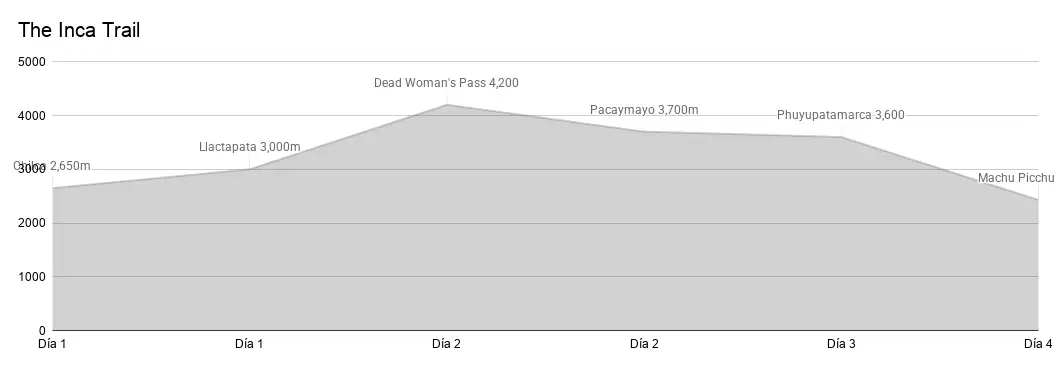
Day 1 Llactapata (2,850m)
Starting the trek at km 82 gives you the chance to warm up gradually as you walk along the Urabamba
river beneath the snowcapped Mt. Veronica to your first camp at the Llacapata Ruins. Approx. walking
4-5hrs. Distance 6km.
Day 2 Pacaymayo (3,700m)
Ascending a broad valley along the course of the Cuischaca river you’ll trek up to Wayllabamba
(3,000m) before climbing steadily and steeply to Pacaymayo. Approx. walking 6-7hrs. Distance 12km.
Day 3 Phuyupatamarca (3,800m)
Today is the most challenging day of the trek with about 1,000m of ascent and descent as you cross both Warmiwanusca (Dead Woman’s Pass 4,200m) and the pass beyond Runkurakay (3,950m) before continuing to Phuyupatamarca. Approx. walking 6-7hrs. Distance 14km.
Day 4 Winay Wayna & Machu Picchu
Descending through the cloud forest and down some 2,000 Inca steps brings you to the beautiful ruins of Winay Wayna (2,700m). From here it is a relatively level path to Inti Punku (The Sun Gate 2,700m) and your first views of Machu Picchu (2,400m). Walking through the site you’ll head to the town of Aguas Calientes here you spend the night. You’ll return first thing in the morning to visit the ruins before the crowds arrive. Approx. walking 4-5hrs. Distance 13km.
The Alternative Trail
This 4 day trail is not subject to permit restrictions
and the route is far less travelled than the classic trail, so you’ll have the freedom to enjoy a host of Inca ruins and remote villages virtually to yourself. Having completed the trek you’ll travel to Aguas Calientes by train to visit Machu Picchu. This trail is available on all our Inca Trail trips; you’ll leave the group for the walk and rejoin them at Machu Picchu.
Day 1 Corimarca (3,740m)
Minibus to Pachar (Sacred Valley). Follow the Huarocondo Gorge a short way upstream to our trailhead at the village of Raphcca, (2,900m). Visit the Inca ruin of Corimarca, high above the Soccma Valley. Camp here, or at a spacious set of Inca terraces a short distance up valley. Approx. walking 5hrs. Distance 5km.
Day 2 Q’eunacancha (4,080m)
Ascend through meadows to the pass of Chancachucu (4,400m). In clear weather this section offers dramatic panoramas of every major peak: Ausangate, the Qoyllur Rit’i range and the Cordillera Urubamba. Cross the pass with views of the glaciers of Verónica to camp at Q’euñacancha. Approx. walking 7hrs. Distance 9km.
Day 3 Cachicata (2,800m)
Continue along the Chancachucu Valley. The stream plunges through Punkuyoc, a narrow ravine enclosed by vertical cliffs. The trail zig-zags steeply down grassy slopes, offering spectacular views of the Camicancha Valley. Enjoy lunch by the Inca complex of Choquetacarpo and camp near Cachicata. Approx. walking 7hrs. Distance 11km.
Day 4 Aguas Calientes
After an early breakfast, travel to Ollantaytambo then on by train to Aguas Calientes to see the famous ruins of Machu Picchu – Overnight at Aguas Calientes. Approx. walking 1.5hrs. Distance 4km.
Extensions
Having explored Machu Picchu you might want to make the most of your time in Latin America and make the cost of the air fare go further. We have two extensions you can easily add onto your Inca Trail trip.
You can explore the huge Amazon Rainforest or the unique Galapagos Islands to experience an unrivalled abundance of wildlife and natural splendour.
Plus, if you book onto the Inca Trail trip we can also take you to Lake Titicaca to see the amazing reed islands of the Uras people.
Amazon
The Amazon Basin covers two-fifths of South America, meaning that no visit to this amazing continent is complete without exploring the most bio-diverse environment in the world. Flying from Cusco to Puerto Maldonado you’ll then head by motorised canoe into the heart of the jungle to your lodge. A stay in the Amazon is like being in another world; for many people the most vivid memories are falling asleep to sounds of the jungle. By day you’ll hopefully see turtles, monkeys and macaws as well as stunning flora.
After the main itinerary
Day 1 Fly to Puerto Maldonado; head by motorised canoe to your jungle lodge.
Day 2/3 Jungle activities; from your base you explore the jungle bothon foot and through the many waterways by canoe, try your hand at fishing for piranha and spot caiman by torchlight at night.
Day 4 Fly to London via Lima.
Extension prices from £440
Planning your trip
When’s the best time go?
The most popular months to trek the Trail are June, July and August, when the weather is warm and visibility is at its best. However, the summer shoulder months; April, May and September are less busy, so walkers will have more time and space to enjoy the trail. In addition, the nights will be warmer and the route will be particularly pretty with more wild orchids en route.
When should I book?
It pays to book early as the number of people on the Inca Trail is limited to 500 a day – including porters, guides and cooks, so around 180-200 paying trekkers can start each day. It is therefore imperative to plan in advance since it can be difficult to secure a permit with less than three month’s notice.
We know this, so to help you make sure you don’t miss out we offer a £50 discount to encourage people to book early at various times of the year. See our brochure or website or speak to a Travel Consultant for details.
Only the classic Inca Trail route requires a permit, so if you’re looking to get away soon you can trek our alternative trail from the Sacred Valley via the Inca quarries of Cachicata. This trek allows you to visit Machu Picchu by bus.
Get the most from your trek – our tips
Make sure you reach Inti Punku (The Sun Gate) early. There will be around 250 other Inca Trail walkers there to capture the sunrise over Machu Picchu so arriving early will allow time to set up cameras for this memorable sight.
Remember also that buses from Aguas Calientes bring day-trippers up regularly during daylight hours, so make the most of your time before the larger crowds arrive.
If you feel up to it, make sure you register at the start of the trail to climb Huayna Picchu, the peak which overlooks Machu Picchu. This peak contains more Incan ruins and the route offers some great aerial views of Machu Picchu.
Best Andes Travel’s trips include regular breaks for refreshments plus three meals a day, but it is also worth taking energy bars and glucose tablets which are easy to digest even if you are not feeling hungry.
The highest point on the trek is at 4,200m. Don’t let the altitude put you off – to help avoid discomfort, buy coca tea before the trek and drink it en route.
How fit do I need to be?
It’s only a 33km walk but do not be lulled into a false sense of security you pass three peaks on the trail, the highest is 4200m Warmiwanusca (Dead Woman’s Pass), Machu Picchu itself is 2400m above sea level. The traditional trail has steep ascents and descents, but nothing that isn’t accessible for a reasonably active person. The High Inca Trail is suitable for trekkers and people who do a lot of outdoor pursuits.
We do recommend improving your overall fitness before the trip to enhance your enjoyment. This means concentrating on aerobic exercises – ones which increase your heart rate. Walks, runs, rowing machines, anything which will raise your heart beat to 60-70% of your max is making your body fitter.
You can determine your max by taking your age off 220 and then determine what 60-70% of this is from there. You can then measure your pulse by placing your fingers onto your major arteries such as your neck or wrist or buying a pulse monitor (£10-£30)
For more details on fitness before your trip read our trekking fitness guide which is available at bestandestravel.com/guides or from a Travel Consultant.
Will I be affected by Altitude Sickness?
As previously mentioned the highest point on the trek is Dead Woman’s Pass (4,200m). Our walks are planned to give your body time to acclimatise and have regular food and drink stops. We can not guarantee you will not feel the affects; it affects everyone in different ways, but most people trek the four days feeling no serious affects from the altitude. To help avoid discomfort drink regularly, we suggest buying coca tea before the trek and drinking it en route. Never just take aspirin to fight off headaches though, this could mask the symptoms of altitude sickness and stop diagnosis by your Group Leader.
What do I need to take with me?
Leave the trail as you found it should underpin your packing plans – don’t pack things you intend to discard after use. To help conserve the trail you’ll need to make sure you add rubber soles to your trekking poles for instance.
Non-covered poles have been banned from the Inca Trail by authorities due to well-founded concerns over erosion.
Weather in the mountains can change quickly and temperatures can vary vastly from day to night, so pack plenty of layers that will help regulate your temperature. Keep wet weather gear easily accessible. All trips with Best Andes Travel are fully supported, so porters will carry your mainbaggage.
Here are some suggestions for your packing list. Bear in mind there is a maximum weight of 7kg for your trek bag on the Trail. However, you can leave luggage not needed on the trek in Cusco.
- Sunhat
- Sunglasses
- Water bottle
- Personal First Aid kit
- Watertight bag for camera
- Torch (and spare batteries)
- Insect repellent
- Sunscreen
- Lip salve
- Towel
- Trainers for relaxing
- Waterproof jacket
- Walking or lightweight trail boots
- 3-season sleeping bag (4-season Jul-Aug) (these can be rented in
Cusco – please ask at time of booking) - Warm hat, gloves and thermal underwear if travelling Jun-Sept
- Lightweight cotton clothing, tight weave for the jungle
- Warm mid-layer i.e. fleece (extra layers in June/July are essential)
For more details on a packing list, baggage, local currency and costs, vaccinations, altitude sickness and other frequently asked questions read the printable Trip Notes which are on each Inca Trail trip web page, or ask a Travel Consultant for details.
More Info
Why is the informational meeting important before going on the hike?
If you have booked onto a trek and have some lingering questions on what to pack, or how to prepare, or are thinking of doing a trekking trip and are wondering what it will be like we have launched Treksmart; a day
of talks and interactive activities to help you prepare for your future trekking trips. These sessions are friendly and fun, and are designed to answer your queries and questions which are at the back of your mind.
The Sessions It usually takes place one or two days before the hike begins (6.30pm – 7.30pm); it can be held at our facilities, at your hotel, or at another agreed-upon location
What life is like on a trek
Pre-trek planning – being organised upfront makes sure you avoid any last minute panics – areas covered include visa, currency, inoculations etc
Kit – We breakdown the huge array of stuff on offer and explain what to take, including demonstrations of what’s best for you or your trip.
Acute Mountain Sickness – one of the biggest areas of concern; we’ll explain what it is, what signs to look for and how to deal with it.
Physicality – we’ll discuss any concerns regarding fitness levels, providing basic tips and plans to help you make the most of the trek.
Self Health Checks – We’ll explain what to lookout for and how best to deal with any issues on trek such as blisters, strains and bites.
Basic outdoor skills – although not needed on your trip we’ll do some practical exercises to get you attuned to mountain life, including some basic princples on map reading and putting up a tent.
Q&As on any unanswered questions
Contact Us
It’s only natural to have more questions, so feel free to visit our website to find out more; our dedicated Inca Trail page brings the trip alive, it includes peoples’ blogs and videos on the trail. From here you can also print off the Trip Notes – a detailed day-to-day breakdown of the trips.
Alternatively, call one of our Travel Consultants on +51 914 403 000 and they’ll be able to answer any questions you have. Many of them can give you firsthand advice having walked the Trail.
It’s important to remember at time of booking to have your passport details available. We need
this to reserve your Inca Trail Permit.